
Triple-Zone Wine Coolers: How It Works and Who Actually Needs One
Key Takeaways
-
A triple-zone cooler holds three independent temperatures in one unit at once.
-
It suits people storing reds, whites, and beverages, or serving and aging together.
-
Dual-zone handles most wine-focused needs at lower cost and complexity.
-
More zones mean smaller sections, so capacity per zone drops as zones rise.
-
Match zones to what you actually store, not to the highest number available.
A triple-zone wine cooler sounds like the obvious upgrade: if two temperature zones are good, three must be better. But more zones are not automatically the right call. A three-zone cooler solves a specific problem for a specific kind of collector and drinker, and for everyone else a single or dual-zone unit does the job with less complexity and cost.
This guide explains how triple-zone wine coolers actually work, how they compare to single and dual-zone units, and, most usefully, how to tell whether you are someone who genuinely benefits from a third zone or someone who does not.
What a Triple-Zone Wine Cooler Actually Does
A triple-zone wine cooler is a single unit with three separately controlled temperature compartments, each set and held independently of the others. In practice, that means one cooler can keep three different things at three different ideal temperatures at the same time.
The reason this matters is that wine and beverages do not all want the same temperature. Red wine is generally served and short-term stored warmer than white, sparkling wine wants cooler still, and everyday beverages like beer, soda, and water are best held colder than any of them. A single-temperature unit forces a compromise across all of that. A triple-zone unit removes the compromise by giving three categories their own environment.
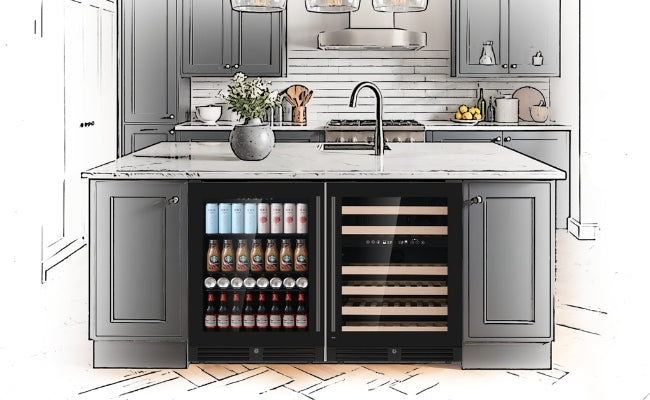
The practical payoff is one appliance instead of two or three. Rather than a wine fridge plus a separate beverage fridge, a well-chosen triple-zone unit consolidates reds, whites, and cold drinks, or serving-ready wine, aging wine, and beverages, into a single footprint. For a kitchen, a bar area, or an entertaining space where counter and cabinet room is limited, that consolidation is the whole appeal.
How Temperature Zones Work
Understanding zones makes the buying decision much clearer, so it helps to see how one, two, and three-zone units differ.
A single-zone cooler holds one temperature throughout. It is the right tool when you store mostly one category of wine, or when you want maximum capacity at one setting, since the entire interior works as a single space. Single-zone units are simple, spacious, and often the best value for a focused collection.
A dual-zone cooler has two independently controlled compartments, typically one warmer and one cooler. This is the workhorse for most wine drinkers, because it comfortably handles reds in one zone and whites or sparkling in the other, or serving temperature in one and longer storage in the other. For a collection that is mostly wine across a couple of styles, dual-zone covers it.
A triple-zone cooler adds a third independently controlled compartment, which is what lets it span three distinct needs at once, most commonly reds, whites, and beverages, or serving wine, aging wine, and cold drinks. The added zone is the point of difference, and whether it earns its place depends entirely on whether you have three genuinely different things to store. The tradeoff to keep in mind, whichever you choose, is that wine storage temperature has a real effect on how wine ages and shows, so matching each category to its correct zone is what makes multi-zone worthwhile.
Who Actually Needs a Triple-Zone Cooler
This is the real question, and it separates the collectors who benefit from those who are paying for a zone they will not use.
You Probably Do Benefit If
You store and serve a genuinely mixed range: reds, whites or sparkling, and everyday beverages, all of which you want held at their own ideal temperature. You entertain often and want serving-ready wine, longer-term storage wine, and cold drinks all in one place without running multiple appliances. You are consolidating, replacing a separate wine fridge and beverage fridge with one integrated unit to save space and simplify a kitchen or bar. Or you keep both wine you are drinking now and wine you are holding for later, and want serving and storage temperatures separated from your beverages.
You Probably Do Not Need One If
Your collection is mostly one type of wine, in which case a single-zone unit gives you more usable capacity at that one temperature. You drink mostly across two styles, where a dual-zone cooler covers reds and whites without the added cost or reduced per-zone space of a third compartment. Or you keep very few beverages alongside your wine, where a dedicated wine cooler plus the occasional shelf beats splitting the unit three ways.
The honest rule is this: a third zone is worth it only if you will genuinely use three different temperatures. If you will not, the zone becomes wasted space and cost.
The Tradeoffs of More Zones
More zones are not free, and understanding the tradeoffs prevents an expensive mismatch.
The main one is capacity per zone. A cooler of a given size divided into three compartments has smaller sections than the same cooler split in two, or used as one. If you have a large collection of mostly one type, three zones may leave each section too small to be practical, and a single or dual-zone unit of the same exterior size would serve you better.
Complexity and cost rise with zones too. More independent compartments mean more controls to set and, typically, a higher price. That cost is well spent when you use all three zones and worth avoiding when you do not. There is also the layout question: because each zone is fixed to a portion of the unit, you want the zone sizes to match your actual split of reds, whites, and beverages, rather than discovering one zone is always full and another always empty.
None of this argues against triple-zone units. It argues for matching the unit to the collection, which is the theme of the whole decision.
Getting the Setup Right
Whichever configuration you choose, a few things make a multi-zone cooler perform its best.
Set each zone to the correct temperature for what it holds, and give the unit time to stabilize after changes rather than expecting instant results. Position the cooler with proper ventilation, since a unit that cannot shed heat struggles to hold multiple temperatures accurately, and ventilation is even more important for multi-zone units working across several setpoints. If the temperatures ever seem off or uneven, it is worth knowing how to troubleshoot wine fridge temperature issues before assuming the unit is faulty, since placement and airflow are common culprits.
It also helps to think about running cost across three actively cooled zones. A multi-zone unit is efficient compared to running several separate fridges, but it still pays to understand how much energy the unit uses so the choice fits your space and budget over the long run.
Frequently Asked Questions
What is the difference between dual-zone and triple-zone wine coolers?
A dual-zone cooler has two independently controlled compartments, usually one warmer for reds and one cooler for whites or sparkling. A triple-zone cooler adds a third independent compartment, letting it hold three distinct temperatures at once, most often reds, whites, and beverages. The third zone suits people storing three genuinely different categories, while dual-zone covers most wine-focused collections at lower cost and complexity.
Who should buy a triple-zone wine cooler?
Someone who stores and serves a genuinely mixed range, reds, whites or sparkling, and everyday beverages, and wants each held at its own ideal temperature. It also suits frequent entertainers consolidating serving wine, aging wine, and cold drinks into one unit, and anyone replacing a separate wine and beverage fridge to save space. If your collection is mostly one or two wine types, a single or dual-zone unit fits better.
Does a triple-zone cooler hold fewer bottles than a single-zone?
For a given exterior size, yes, in the sense that dividing the interior into three compartments makes each section smaller than the same cabinet used as one space. That is the core tradeoff of more zones. If you have a large collection of mostly one wine type, a single-zone unit gives more usable capacity, while triple-zone trades some per-zone space for the ability to hold three temperatures at once.
Can I store wine and beverages in the same cooler?
Yes, and that is exactly what multi-zone coolers are built for. A dual or triple-zone unit lets you keep wine at its proper storage or serving temperature in one zone while holding beer, soda, and water colder in another, all in one appliance. A triple-zone unit goes further, separating reds, whites, and beverages, which is ideal if you regularly keep all three on hand.
Deciding on a Triple-Zone Cooler
Triple-zone wine coolers are an excellent solution for the right person: someone storing reds, whites, and beverages, or serving and aging wine alongside cold drinks, who wants it all in one unit at the correct temperatures. For a collection centered on one or two wine styles, a single or dual-zone cooler does the job with more usable space and less cost. The decision is not about buying the most zones available, but about matching the zones to what you genuinely store.
Explore KingsBottle's wine and beverage combo systems and full wine cooler range to find single, dual, and triple-zone units matched to your collection, with under-counter and upright formats for kitchens, bars, and entertaining spaces.